Thursday, February 21, 2013

Spiral Router Bits


Question:-I have a question about spiral router bits as I have no experience using them. I have a chance to get a couple but with limited funds right now, I only want to get ones that I would use frequently. What type (up/down/compression), what diameter, and what function would you use them. From everything I’ve read it looks like an up-cut bit is used for hand-held routing when doing mortises and a down cut for router table work for dadoes, rabbets grooves. What are your thoughts? Thanks and keep up the great work!

Answer:- Quality solid carbide spiral bits combine effective chip removal with a continuous shearing action cut not obtained from a standard straight bit. You’ll get smoother cutting action with better results.

Up-cut Bits provide faster cutting while they pull chips up and out of the work or towards the router. They are excellent bits to use when cutting material in a router table since they tend to hold the work piece to the table itself. Ideal for mortise and tenons, grooving, slotting or routing deep blind holes. Down-cut Bits cut slower and push chips away from the router to eliminate top surface splintering. Use for pattern cutting or when going completely through the board as it allows clear vision of the cutting line. Ideal for fine finish work such as veneers, laminates, inlays and repairs because they prevent upper edge tear outs. Use Down-cuts for trimming and sizing.

Compression Bits Cuts through stock and gives clean cuts in both top and bottom. No tear out as bit is designed to pull work into the center of the stock. Ideal for double sided veneer plywood, melamine, and laminates. As for size recommendations, it really depends on the specific application you intend to use the bit for. We find that the 1/8″, 1/4″ and 1/2″ Up-cut and the 1/4″ and 1/2″ Compression bits are the most popular for our customers applications.


CNC / CAD /CAM links


Monday, February 18, 2013

Knowing your CNC Router Machine Software

Hi,
We all know that what sets the CNC machine apart from all other manual tools in the manufacturing industry is its computerized nature. Instead of having to manually operate certain tools, we use computers to input commands and allow the machine to follow your instructions to the dot. For our part, it makes everything more convenient and accurate. This is why the software is important. It’s the software that translates your data into something that could be understood by the machine. That way, the machine can process the raw material and turn it into the exact result which you imagined and patterned.

However, there is no such thing as a one-size-fits-all type of software. Naturally, different manufacturers and brands compete by offering the best CNC router machine software that they can develop. They also build different types of software to best fit the purpose of a particular model. CNC machine software is often classified in two perspectives:

  1. Software availability (i.e. freeware, built-in, and independent)
  2. Purpose (i.e. as to the machine’s main function?)

If you’re planning on investing in CNC routers, you’ll eventually have to deal with the software. It’s ideal that you know how each of these types varies from one another. That way, you can make better choices when you need to replace the built-in software of your machine. Anyway, it’s not so hard to figure out the classification of the software in terms of purpose, since it’s all about matching the software to a type of machine, which could either be:

  1. Router;
  2. Engraver; or
  3. Plasma Cutter;

These three require different kinds of software simply because they function differently. CNC router machine software is designed to let users input dimensions in cuts and shapes more accurately in wood routing. A router’s main function, after all, is to cut through wood at a specific depth and angle. CNC routers may also differ in terms of axis flexibility. Thus, a 5-axis router might work better with a certain type of software as opposed to the typical 5-axis router.

The CNC engraver, however, focuses more on tasks that require a bit of intricate design. Instead of straight and measure angles and depths, you need to work with patterns and images which you have actually drawn. That’s why this type of machine would need CNC engraver machine software.

There are those who might say that a CNC plasma cutter has the same function as a router. This may be true, since both do cutting tasks. The only difference is that they cut different materials. Routers cut wood, while plasma is intended for sheets of metal. But this difference on the raw material used alone calls plasma cutters to use CNC plasma cutter software.

Keep these things in mind next time you plan on getting new software for your CNC machine. If you’re still confused about matters on compatibility and the different features of different programs, you can always ask your manufacturer for advice.


About the company:

At ez Router, we've made it our business to offer robust, affordable and easy to use hobby CNC and business CNC cutting machines. We've got a model for every place and space in CNC routers, oxy-fuel and CNC plasma cutters.

Saturday, December 15, 2012

The Coonskin Signage


These were made on my home made HB2 CNC router using 
Vectric Aspire software and a few other computer control programs.

Monday, August 13, 2012

Future Fabrications


Here's an unusual take on how we might build things in the future: The subversive Danish creative collective known as N55's Spaceplates. The idea is that we would have the proverbial shit-ton of sheet goods delivered to our home, and we'd break out a domestic CNC, download some plans and have it start carving up modular units that we'd then put together.


N55 in collaboration with Anne Romme and Sam Kronick are prototyping a new building system called SPACEPLATES based on the geometry found in animal shells like the sea urchin. Its a low cost way of creating approximated double curved surfaces in a statically well defined way, minimizing the material use. When the system is ready, persons should be able to " print out" a SPACEPLATES construction ( a home, a greenhouse or a larger communal building), using materials like PC or aluminum and a CNC- router. (Even a small table version- cnc router will work).

CNC / CAD /CAM links

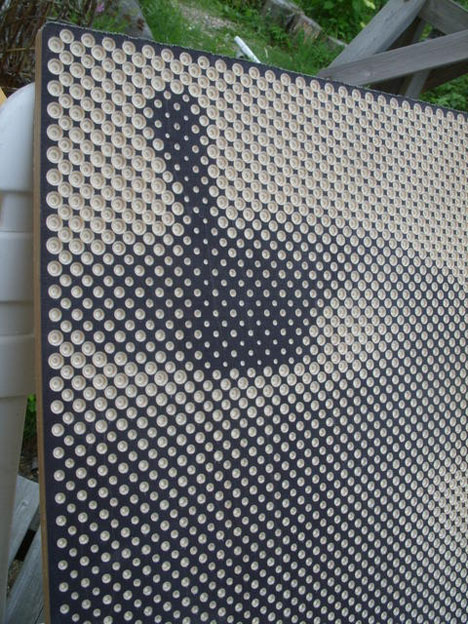
Pixels in Plywood


A Finland-based artist going by the name of "Tomi" has created pixel art using an MDF-based CNC router to drill holes of different depths into stained plywood. The resultant halftone images take about an hour to produce and contain roughly 3,000 "pixels:"

Tomi is part of the DIY CNC movement, and if you're curious to see pictures and details of both his work and the machine's set-up, you can check both out here.

making_a_mountain_out_of_a_piece_of_plywood


Ok, so it's actually just a combination of a wall-sized CNC-routed halftone and a climbing wall—a scaled-down scalable surface, but it's a noteworthy DIY project nonetheless. For $200 and "not more than a day" of savoir-faire, 3-axis routing and elbow-grease designer Christoph Schindler (half of Zurich-based "furniture architecture" firm Schindler Salmeró) built the "Fitz Roy Climbing Wall" as a birthday gift for his son.
We used a 2500 x 1250 x 15 mm plywood-board and painted it. The hole pattern for the image and the holes for the climbing holds were drilled with an old CNC 3-axis-router. Although the pattern looks complex, there was no scripting involved and everything was prepared with standard software tools.

For those of you who have said resources, Schindler's provided detailed instructions of the entire process:
First we selected a nice image, in our case we decided for an image of Fitz Roy in Patagonia. Then we created a surface with the "heightfield from image"-operation in Rhino, choosing a height of 3mm (see below). The milling is done with "Plunge Roughing," a standard CAM operation. In Plunge Roughing, the tool makes a series of plunges to remove cylindrical plugs of material. To get our pattern, we chose for an usual large distance of the plunges. The selected tool is a 6 mm-Ballnose-Tool. To use the radius of the ballnose for different hole diameters, the height difference of the surface equals the radius of the tool (this is were the 3mm come from). If the paint is applied before milling, the holes and the white background contrast sharply.
 After this operation, the triangular grid of holes for the climbing holds are prepared, as well with the router. Then the plywood is turned and the T-nuts are fixed with a hammer... we have a total of 97 holes and started with a set of 15 climbing holds. The position of the holds can be altered any time and there are enough T-nuts to get more holds or fix other gear like a rope.

Saturday, June 9, 2012

Profiled metals for marine customers

Independent multi-metal stockholder Aalco can also offers customers in the marine industry a full profiling service using a 3-axis CNC router.
Aalco stocks an extensive inventory of aluminium, stainless steel, copper, brass, bronze and nickel alloys in all semi-finished forms covering a wide range of grades/alloys, shapes and sizes - both industry standards and special or bespoke items for particular applications or individual requirements.
The Aalco service offer to the marine industry is further enhanced by a 'MultiCam' 3 Axis CNC Profiling Router, complete with a 9m x 2.44m vacuum table, which is installed at the Southampton Service Centre. This gives Aalco the capability to offer customers, commercial suppliers, boat builders & subcontractors a full profiling service using the latest CNC technology. Aluminium bespoke components can be profiled to customers’ drawings & supplied as single parts or in kit form. Components can be engraved with identification marks and datum lines for ease of manufacture.
Jeremy Chase, Product Development Manager for the CNC Profiling Centre comments;
“I have worked in the marine industry for 34 years and as a previous customer, had always been impressed by Aalco’s ability and willingness to work with customers as a key part of the supply chain”
“Now that I have had the opportunity to move to the supply-side I am able to bring knowledge and experience from a customer perspective to make the best metals supply service even better”
To reinforce the company’s ability to service the marine industry, Aalco stocks 9000 x 2000 and 6000 x 2000 Dual Certified 5083-O LRS/DNV 3.2 and also 5083 H321 DNV 3.2 material in various gauges.
Aalco provides customers with a cost-effective single source for all their metals requirements, together with a comprehensive processing service which includes polishing, coating, blanking and 'cut to length'
Marine industry customers include the MOD, commercial shipbuilders, repair yards and the rapidly expanding offshore energy generating industry.